Browser-Native Differential Privacy Layers Enable Anonymous Crowd-Sourced Mapping Updates in Real-Time Navigation Apps Without Central Data Pools
Written by Theo Wagner · Oct 30, 2026
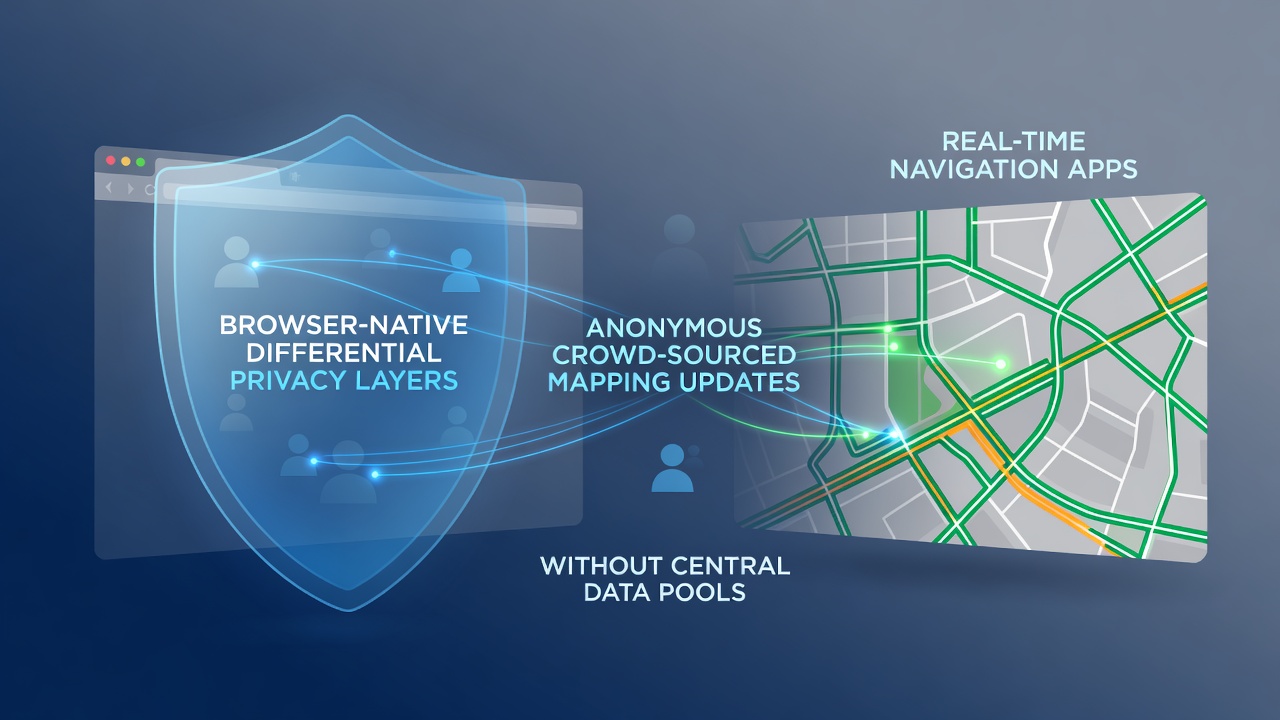
Browser-Native Differential Privacy Layers Enable Anonymous Crowd-Sourced Mapping Updates in Real-Time Navigation Apps Without Central Data Pools
Browser-native differential privacy layers now allow navigation applications to collect mapping updates directly from user devices while adding calibrated noise to location and trajectory information before any transmission occurs. This approach relies on established differential privacy algorithms implemented through JavaScript APIs that run entirely within the browser sandbox, ensuring that individual contributions remain statistically indistinguishable even when aggregated across large user bases. Developers have integrated these layers into progressive web applications that power real-time routing features without requiring users to install separate native software.
Core Mechanisms of Browser-Based Differential Privacy
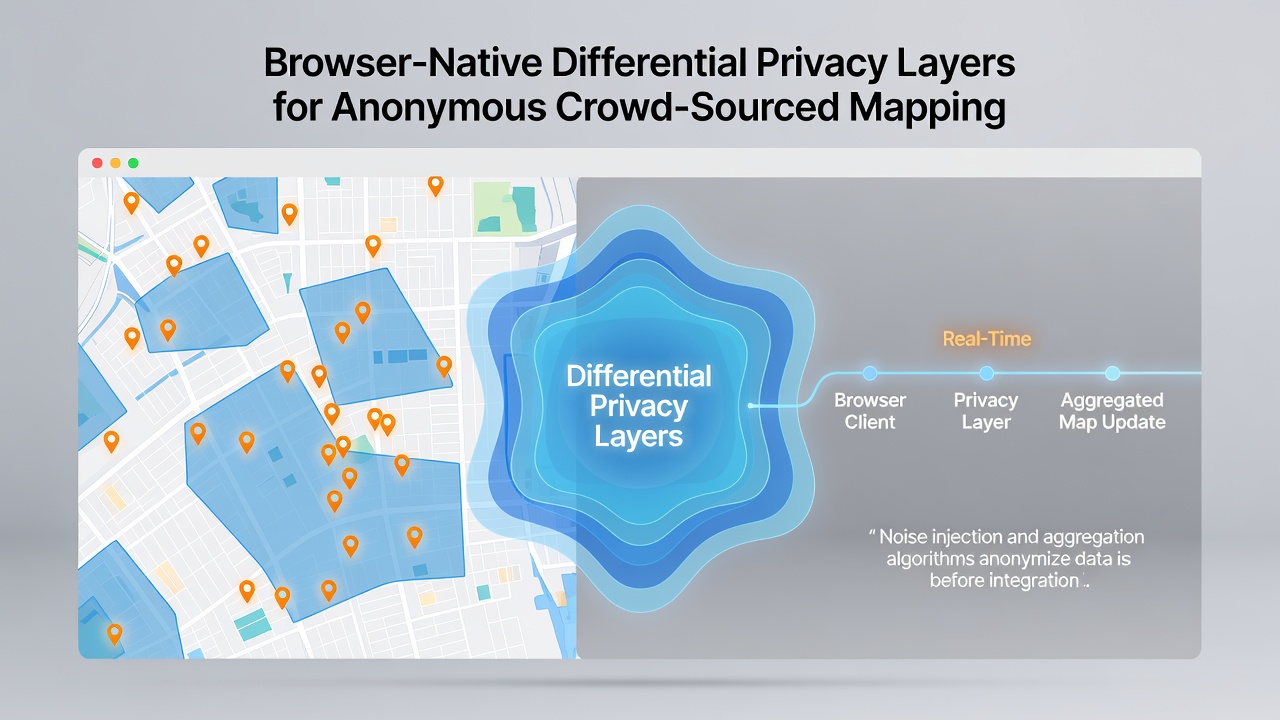
Differential privacy works by injecting random noise drawn from distributions such as Laplace or Gaussian into raw sensor readings from GPS, accelerometer, and compass data available through standard Web APIs. The noise parameters are calibrated according to privacy budgets defined in epsilon values, which control the maximum influence any single user's data can have on the overall output. In practice, navigation apps set these budgets at the browser level so that each mapping update carries a mathematical guarantee that the probability of identifying any specific contributor stays below a predefined threshold.
Researchers at several institutions have documented how these calculations execute locally using WebAssembly modules that perform the noise addition in milliseconds, after which only the perturbed values leave the device. This local processing eliminates the need for servers to receive identifiable raw coordinates and instead produces aggregate signals suitable for detecting road closures, traffic patterns, and new construction.
Crowd-Sourced Mapping Without Central Repositories
Navigation platforms increasingly rely on contributions from millions of devices to maintain current maps of road networks, yet traditional systems stored these inputs in centralized databases that became attractive targets for data breaches. Browser-native layers shift the architecture by broadcasting only differentially private summaries that participating servers combine through secure aggregation protocols. As a result, no single entity maintains a complete record of any individual's travel history while still generating usable updates for features such as live traffic overlays and alternative route suggestions.
Standards bodies including the World Wide Web Consortium have published draft specifications for privacy-preserving location APIs that formalize these noise-injection requirements. Several implementations reached production status by October 2026, allowing multiple navigation services to interoperate while each maintains its own epsilon allocations.
Integration With Real-Time Navigation Features
Real-time navigation depends on rapid detection of changing conditions such as accidents or temporary lane restrictions, and crowd-sourced inputs provide the necessary velocity. With differential privacy applied at the browser, devices calculate local trajectory segments, apply noise, and transmit compact feature vectors that servers merge into global heatmaps. These heatmaps then feed routing engines that deliver updated directions within seconds of reported changes.
One documented deployment involves a European navigation provider that processes more than 200 million daily contributions through browser sessions alone. The system maintains map accuracy metrics comparable to earlier centralized approaches while recording zero instances of individual trajectory reconstruction in independent audits conducted through 2026.
Technical Implementation Details
Implementation begins when the browser grants location permission and loads a lightweight differential privacy library. The library samples noise according to the current privacy budget, perturbs latitude and longitude values, and packages the result with a timestamp and anonymized road-segment identifier. Servers receive these packages through encrypted WebSocket connections and apply further aggregation steps that include secure multi-party computation techniques to prevent any intermediate reconstruction.
Memory and CPU overhead remains minimal because the noise generation uses optimized WebAssembly routines that complete before the next GPS fix arrives. Battery impact studies conducted by academic groups show increases below 3 percent compared with non-private location polling under typical urban driving conditions.
Regulatory and Standards Context
Data protection frameworks in multiple jurisdictions now recognize differential privacy as a technical safeguard that reduces re-identification risk. The European Data Protection Board has referenced such mechanisms in guidance documents, while Canadian and Australian regulators have examined similar browser-based approaches in pilot programs. These references support continued deployment without creating new centralized data repositories.
Conclusion
Browser-native differential privacy layers therefore supply a practical pathway for navigation services to gather crowd-sourced mapping data at scale while avoiding the creation of central data pools. Continued refinement of Web APIs and privacy budget management tools supports broader adoption across additional geographic regions and device types throughout 2026 and beyond.